
Practical Approaches to Increasing the Sustainability of Metalworking Fluids
In today’s world, as awareness of global warming increases, sustainability continues to play a critical role for the manufacturing industry, achieving carbon neutrality to build a cleaner future becoming a paramount concern. As industries seek to improve their environmental footprint, sustainable solutions play a key role in enhancing health, safety, and air and water quality. These solutions also support efforts to reduce carbon emissions and contribute to broader decarbonization objectives. In line with this goal, metalworking fluid manufacturers are constantly working to develop ecodesigned solutions that meet today’s requirements without compromising productivity or performance.
Choosing Among Metalworking Fluids
The use of appropriate products containing less hazardous components and exhibiting lower toxicity is the first step toward achieving a more sustainable cycle. When selecting a product, base oils and additives used in metalworking fluids (MWFs) should be examined in terms of health and safety and their harmful effects on the environment. Accordingly, it is recommended that components such as oils containing polycyclic aromatic hydrocarbons (PAHs), para-tert-Butylbenzoic acid (PTBBA) and chlorinated paraffins, nitrites, sodium nitrate, phenols, alkanolamines, secondary amines, boron, and formaldehyde-releasing biocides should be avoided.
The biocide used should comply with applicable regulations and should not exceed the concentration required to meet fluid specifications, as an excessive amount may cause dermatitis and skin irritation or sensitization in workers.
Components with potential adverse effects on health, safety, and the environment can easily be identified in the product Safety Data Sheets (SDS). In that regard, products without hazard pictograms or precautionary statements should be preferred.
Another criterion in product selection is flammability and resistance to evaporation. Flammability poses a significant fire hazard, especially in pure cutting and solvent containing products. However, this does not mean that such risks are absent in soluble lubricants. In fact, MWFs with high oil content also pose a risk due to the evaporation of their water content. The most effective way to mitigate the risks of fire and evaporation when selecting a product is to choose products with a high flash point.
Similarly, the products with high evaporation rates may increase inhalation exposure, potentially affecting worker health, compromising safety increase consumption, and lead to dirty and greasy workshop environments. Therefore, priority should always be given to products with high resistance to evaporation. In addition to all of the above considerations, since petroleum-derived products inherently have low resistance to microbiological growth , oil-free and emulsifier -free products designed to reduce environmental impact and have superior lubrication performance should be the first choice when selecting the most sustainable MWF’s.
Managing Fluid Quality
Once the product is selected, a specific procedure must be followed during the use of MWFs. Primarily, all products should be transported and stored between 5°C and 40°C, kept indoors in their original containers with closed lids, protected from direct sunlight and humidity, and used before their expiration date. If stored outdoors, precautionary measures should be taken to avoid contamination from weather conditions, such as placing containers horizontally so moisture cannot infiltrate the bung or storing them under a protective cover. Before use after a long storage period, it is recommended to analyze the product before use, as certain unwanted degradation by-products (such as nitrosamines) may form under specific conditions.
Considering that approximately 90-95% of the water-based liquid sump consists of water, water quality is just as important as the choice of oil, and it varies greatly depending on the source. It may contain dissolved minerals, organic matter, or microorganisms that can have health and safety implications, and affect fluid performance. Therefore, it is vital to ensure adequate water quality, not only to ensure emulsion stability but also to reduce both fluid consumption and disposal. The water used for the preparation of the cutting fluid should be clean and, according to TotalEnergies Lubrifiants’ recommendations, neutral (pH approx. 7), and regularly tested to evaluate whether it complies with the reference values given below. the reference values given below.
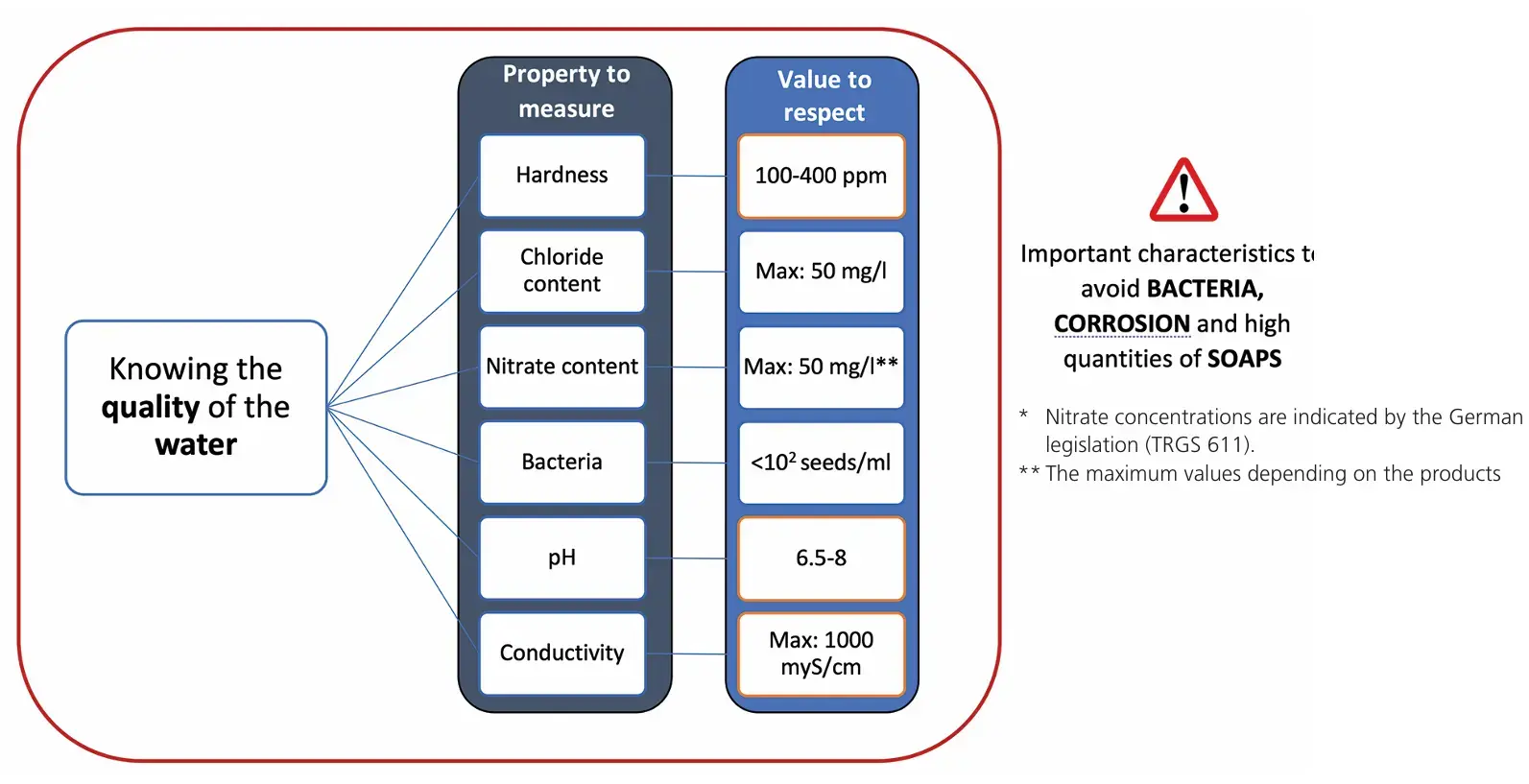
The closer the water properties are to the ideal values– preferably similar to deionized water depending on the product– the longer the stability and service life of the bath.
Before using soluble cutting fluids, the system must be thoroughly cleaned of dirt, soap residues, and microbiological contamination by adding 1% to 3% system cleaner to the sump to be replaced, while the machine continues operating. The system cleaner must run on the system for at least 24 hours before the old sump is emptied to ensure the system is chemically purged. Prolonged contact with the cleaning agent should be avoided to prevent skin irritation. It is highly recommended to rinse the system several times with water, preferably by adding 1% new oil to the water, after the tank has been completely drained of the lubricant and any remaining solid debris. If in doubt, consult your fluid supplier or machine manufacturer for advice and guidance.
As sump stability is the most critical property of soluble MWFs, a specific mixing procedure must be followed when preparing the sump. It is recommended that an automatic mixer is used, if possible, at a minimum ambient temperature of 10°C, to maintain a proper mixture, balanced in terms of alkalinity, acidity, and hydrophilic lipophylic balance (HLB). Taking a sample from the newly prepared sump is advisable, as it helps monitor the bath and detect any anomalies that may cause future problems. Since soluble oils are highly vulnerable to microbiological attacks (bacteria, fungi, and yeast), substances such as carbon, nitrogen, phosphorus, and sulphur provide nutrients for these microorganisms. These organisms can deteriorate emulsion quality and affect workers’ health.
There are other parameters to be monitored, such as appearance, odor, tramp oil content, pressure, flow rate, tank fluid level, temperature, and conductivity, to prevent future health and safety issues and maximize operational efficiency. After all, maintaining control over these quality parameters also helps reduce waste and, consequently, total costs.
System Design
To ensure maximum efficiency and sustainability, tank dimensions are also an important factor to consider. Using an undersized or low-volume tank can cause MWFs to overheat, increasing bath concentration due to water evaporation. Topping up the bath with water to adjust the concentration level may increase water hardness and chlorine content, leading to the formation of calcium soaps and corrosion problems. Other issues that may arise include excessive fluid consumption caused by overflow due to filter blockage and accelerated bacterial and fungal growth due to increased tramp oil levels.
In oversized tanks, there may be increased growth of anaerobic microorganisms due to poor aeration, as well as reduced filtration efficiency and accumulation of deposits at the bottom of the tank.
Commonly, the volume of the tank is recommended to be approximately eight times the pump flow rate (L/min) for general machining, and sixteen times the flow rate for grinding operations.
By complementing the system design with the separation of equipment such as filtration, skimmers, and local exhaust ventilation (LEV), significant contributions can be made to the sustainability of MWFs operations. Several parameters should be considered before selecting equipment, including material properties, flow rate and volume, and fluid characteristics. In general, magnetic and sedimentation systems are used to separate solid particles. However, filter papers are more effective for separating swarf and fine metallic particles, as some of them, such as aluminum and magnesium, can be highly reactive and even explosive. Also, metals such as nickel, chromium, or lead can cause allergic reactions. Since removing tramp oil allows the fluid to aerate properly, skimmers and coalescers should be essential components of the separation system.
In order to ensure risks to workers are adequately controlled, appropriate measures should be implemented to limit exposure to MWF mists, including engineering controls such as local exhaust ventilation (LEV), which can significantly improve air quality in workshops.
In conclusion, achieving a more sustainable and less hazardous production system without compromising productivity is no longer a dream. By following all recommended practices (from careful the product selection to consistent maintenance and proper system design), each measure contributes to reducing exposure and associated risks, while improving processing efficiency, and minimizing chemical use and hazardous waste generation.